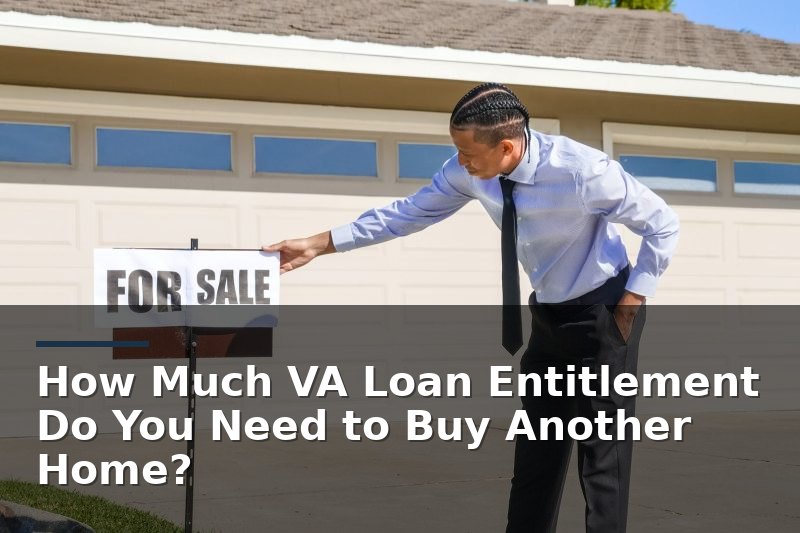
How Much VA Loan Entitlement Do You Need to Buy Another Home?
Buying another home with a VA loan can get confusing fast when some of your entitlement is tied to a property you already own.
VA loan entitlement is the amount the Department of Veterans Affairs will guarantee, and you need enough available entitlement to cover the required guaranty on your next VA loan.
In this guide, I’ll show you how full and remaining entitlement work, how lenders calculate the numbers, and when a down payment may be required.
Key Takeaways
- Full Entitlement: Eligible borrowers with full entitlement do not have a VA loan limit, though income, credit, appraisal, and lender guidelines still apply.
- Remaining Entitlement: If part of your entitlement is tied to another VA loan, the new property’s county loan limit becomes part of the calculation.
- Down Payment: A down payment may be required when the new loan exceeds the amount supported by your remaining entitlement.
- Verification: Your Certificate of Eligibility shows entitlement information, but a lender still needs to calculate how it applies to the new purchase.
I’m Matt Jolivette (NMLS# 90661), and I help VA borrowers in Oregon, Washington, and Idaho review these calculations before they write an offer. The goal is simple: put the real math in front of you so you know what the next purchase may require.
Quick Answers
- Is VA entitlement the same as a down payment? No. Entitlement is the portion of the loan the VA guarantees to the lender. It can affect whether you need a down payment, but it is not cash you receive.
- Does full entitlement create a maximum purchase price? No. VA loan limits do not apply when you have full entitlement, but the lender must still approve the loan based on your finances and the property.
- Can remaining entitlement change based on location? Yes. With partial entitlement, the conforming loan limit for the county where you are buying is used in the calculation.
- Does a Certificate of Eligibility guarantee approval? No. It confirms VA eligibility and provides entitlement information. Loan approval also depends on underwriting, occupancy, appraisal, and property requirements.
How VA Loan Entitlement Works
Here’s the straight talk. Entitlement is not the amount you can borrow. It is the amount of guaranty the VA provides behind your loan.
That guaranty reduces the lender’s risk and is one reason qualified borrowers may be able to purchase a primary residence with no down payment. VA financing also does not require monthly mortgage insurance, although a VA funding fee may apply unless the borrower qualifies for an exemption.
The VA guaranty is commonly structured around 25% of the loan amount. That percentage matters most when a lender calculates whether your available entitlement fully supports the new loan.
You can generally fall into one of two categories:
- Full entitlement: None of your usable entitlement is currently tied up, or your entitlement has been restored.
- Remaining entitlement: Some entitlement is still connected to another VA loan or has not been restored.
How Much Entitlement Do You Need With Full Entitlement?
If your Certificate of Eligibility shows full entitlement, there is no VA loan limit restricting the size of the loan. That does not mean you can borrow any amount you want. It means the VA loan limit itself is not the cap.
Your maximum loan still depends on factors such as:
- Documented income and employment
- Credit history
- Monthly debts and residual income
- Cash needed for closing costs and reserves
- The property’s appraised value
- VA property and occupancy requirements
- Any lender overlays beyond the VA’s baseline guidelines
VA eligibility, loan qualification, and property approval are three separate parts of the file. Having full entitlement handles only one part of that picture.
How Remaining VA Entitlement Is Calculated
If you have an active VA loan, you may still be able to use VA financing again. The lender needs to determine how much entitlement was used on the first loan and how much remains for the next one.
With partial entitlement, the calculation generally starts with 25% of the current conforming loan limit for the county where the new home is located. The entitlement already charged to your existing VA loan is then subtracted.
A simplified version looks like this:
Maximum county guaranty minus entitlement already used equals remaining entitlement.
The lender then compares that remaining entitlement with 25% of the proposed new loan amount. If the remaining entitlement covers the required guaranty, a down payment may not be needed. If it does not, the borrower generally contributes enough to cover the shortage.
County limits can differ between Multnomah County, Clackamas County, Washington County, Clark County, and other areas. Current limits also change over time, so the calculation should be updated for the property you are actually considering.
A Simple Way to Think About the Down Payment
Let’s run the numbers without tying this to a loan limit that may change.
- Determine 25% of the proposed new VA loan amount.
- Calculate the entitlement still available for the county of the new home.
- Subtract the available entitlement from the required guaranty.
- If there is a shortage, that shortage is generally the minimum down payment needed to satisfy the guaranty calculation.
This is not a complete approval calculation. Loan amount, closing costs, appraisal results, funding fee treatment, and lender guidelines can all affect the final structure.
Can You Have Two VA Loans at the Same Time?
Yes, it is possible to have two VA loans at the same time if you have enough remaining entitlement and meet the occupancy and underwriting requirements.
A common setup is keeping a home financed with a VA loan and buying another primary residence after a qualifying move. The old home may remain as a second home or rental property, but the new property generally needs to become your primary residence.
The lender will also review whether you can support both housing payments. Rental income from the departing residence may help in some cases, but documentation rules vary. A lease, rental history, equity position, or reserves may be required depending on the loan program and lender.
Entitlement alone does not remove those requirements. It only tells us whether the VA guaranty can support the new loan and whether a down payment may be needed.
When Can VA Entitlement Be Restored?
Entitlement can commonly be restored after the prior VA loan is paid in full and the property is sold. Restoration is not always automatic. The VA may need a restoration request and supporting documentation before the Certificate of Eligibility updates.
There is also a one-time restoration option that may allow entitlement to be restored after a VA loan is paid off even if you still own the property. That option has specific consequences, so I would review the long-term plan before using it.
If you plan to sell your current home and use the sale proceeds to pay off its VA loan, timing matters. The payoff, sale, restoration, and new closing may need to be coordinated. Build extra room into the contract whenever possible because an entitlement update can take time.
What If Your Current Home Has an Assumed VA Loan?
A VA loan assumption does not always release your entitlement. If another eligible veteran assumes the loan and substitutes their entitlement for yours, your entitlement may be restored. If no substitution occurs, your entitlement can remain tied to that mortgage until it is paid off.
This matters because you may no longer own the home but still have reduced entitlement. It also means the assumed loan can affect your ability to purchase another home with no down payment.
Before agreeing to an assumption, confirm in writing whether entitlement substitution is part of the transaction. Do not assume the transfer of ownership automatically restores it.
What Documents Will the Lender Review?
The first document is your current Certificate of Eligibility. A lender can often request it electronically, but additional records may be needed if the entitlement shown does not match your loan history.
Depending on your situation, expect the lender to review:
- Your Certificate of Eligibility
- The current mortgage statement for any active VA loan
- The closing statement from a prior sale
- Proof that a previous VA loan was paid in full
- Assumption or entitlement-substitution paperwork
- Lease and rental documentation for a departing residence
- Income, asset, credit, and debt documentation for the new loan
Old VA loans, refinances, assumptions, and property sales can make the entitlement section of a Certificate of Eligibility hard to read. That is normal. The answer should come from the VA record and current calculation, not a guess based on the original loan amount.
VA Entitlement Versus ODVA Financing
Oregon veterans may also want to compare the federal VA program with the state’s ODVA loan program. They are separate programs with different eligibility rules, structures, and property requirements.
ODVA should not be treated as a replacement version of the federal VA benefit. Depending on your goal, it may make sense to compare VA, ODVA, conventional, and other low down payment purchase options side by side.
How to Plan Before Making an Offer
Do not wait until you are under contract to find out how much entitlement remains. A clean pre-approval review should address the entitlement calculation early, especially if you are keeping another VA-financed property.
I would confirm these items before setting a purchase range:
- Pull the current Certificate of Eligibility.
- Verify every prior or active VA loan listed.
- Confirm the county where the new property will be located.
- Calculate the remaining guaranty and any possible down payment.
- Review both housing payments and any usable rental income.
- Confirm cash needed for closing costs, reserves, and the funding fee if applicable.
Buying in Portland, Lake Oswego, Tigard, Beaverton, Vancouver, or Boise can produce different calculations because county loan limits and property details vary. The purchase price that works with no down payment in one county may require money down in another when you have partial entitlement.
My Honest Take
Do not focus only on whether you can reuse the VA benefit. Focus on what the full payment and cash requirement look like after the entitlement calculation is finished.
Sometimes keeping the first property and using remaining entitlement makes sense. Sometimes selling, restoring entitlement, or comparing a conventional loan gives you a cleaner structure. The right answer depends on the current VA loan, the new purchase price, the county, your cash, and your long-term plan.
If you are considering another home, call, text, or email me before you make an offer. I can review your Certificate of Eligibility, compare the options side by side, and explain the pre-approval steps. No pressure either way.
Associated Mortgage Brokers is an independent mortgage brokerage, Company NMLS #86136.
Frequently Asked Questions
How do I restore VA entitlement after selling a home?
The prior VA loan generally must be paid in full, and the VA may require a restoration request with proof of payoff and sale. A lender can help request an updated Certificate of Eligibility before the next purchase.
What is one-time restoration of VA entitlement?
One-time restoration may allow you to restore entitlement after paying off a VA loan while keeping the property. Because the benefit is generally available only once under this provision, review future plans before using it.
Will refinancing my old VA loan into a conventional loan restore entitlement?
Paying off the VA loan through a conventional refinance may allow restoration, but keeping the property generally requires use of the one-time restoration provision. The VA must update the entitlement record before you rely on it for another purchase.
How does entitlement work on a VA joint loan?
Joint loans can involve more detailed guaranty calculations, especially when a co-borrower is not using VA entitlement. The required down payment and guaranty depend on the borrower structure, so current VA and lender guidelines need to be reviewed.
What happens to entitlement after a foreclosure or short sale?
A VA loss can reduce the entitlement available for future use, but it does not always eliminate the benefit completely. Future eligibility, waiting periods, credit requirements, and remaining entitlement must all be reviewed under current guidelines.

Matt Jolivette
Matt Jolivette, NMLS #90661, is a mortgage broker and co-owner of Associated Mortgage Brokers, company NMLS #86136. He began at the company as a loan processor in 2000, became a loan originator in 2001 and became a co-owner in 2011. He earned a Bachelor of Science degree in Finance from Portland State University in 2005.
Related Posts