
Mortgage preparation for company drivers and owner-operators
Truck drivers may qualify for conventional, FHA, VA or lender-specific bank statement financing based on their documented income, credit, assets and property. How you are paid matters: W-2 wages, mileage pay, expense reimbursements and self-employment receipts are not interchangeable. This guide explains what to prepare for a mortgage conversation in Portland and across Oregon, Washington and Idaho.
I’m Matt Jolivette, CMC® (NMLS #90661), with Associated Mortgage Brokers. I began in mortgage processing in 2000 and became a loan originator in 2001. I help borrowers compare eligible financing and understand the costs and documentation involved.
How your employment type affects the review
Company drivers paid as W-2 employees
Prepare recent pay statements, W-2 forms and employment information. Identify base pay, mileage earnings, bonuses, overtime and reimbursements separately. The lender reviews income history, changes and expected continuance under the selected program; gross pay on one statement does not establish qualifying income.
Owner-operators and independent contractors
Prepare the tax returns, business records, profit-and-loss information and account statements requested by the lender. Business expenses, debt obligations and cash-flow trends affect the analysis. A change from employee to self-employed work requires review; it does not automatically reset a universal eligibility clock.
Required history and tax documentation vary. Some conventional scenarios permit a shorter self-employment history when additional criteria are met. Review Fannie Mae’s self-employed borrower guidance with your mortgage professional rather than assuming every lender follows one rule.
Documents to discuss
| Review area | Company driver | Owner-operator |
|---|---|---|
| Income | Documented eligible wages and variable pay | Eligible business income after required analysis |
| History | Program-specific employment and earnings review | Program-specific business history and continuity review |
| Documents | Pay statements, W-2s and employer information | Requested tax records, business financials and account statements |
| Expenses | Separate reimbursements from eligible income | Review operating expenses and business debts |
Per diem, reimbursements and qualifying income
Per diem is not automatically qualifying income. A lender must determine what the payment represents, document its treatment and apply the selected program’s rules. An expense reimbursement should not be treated as additional spendable income without that review.
Provide pay statements, employer explanations and relevant tax records. Any adjustment for eligible nontaxable income is program-specific; this guide does not promise a standard increase to your income.
Mortgage options to compare
Conventional financing
Conforming loans use program-specific income, credit, property and loan-limit rules. Compare cash to close, mortgage insurance when applicable, and total borrowing cost. A smaller payment or down payment does not automatically make a loan less expensive.
FHA financing
FHA loans require borrower and property eligibility and include mortgage insurance. Variable income still needs documentation and analysis. Compare the upfront and ongoing costs with other eligible programs.
VA financing
VA loans may be available to eligible veterans, service members and certain surviving spouses. Service eligibility does not guarantee mortgage approval. Entitlement, appraised value, lender requirements and any applicable funding fee affect the transaction; monthly mortgage insurance is not required.
Bank statement financing
Bank statement loans may provide an alternative income-documentation path for eligible self-employed borrowers. Not all deposits qualify. The lender reviews expenses, transfers, business activity and other required records; rates, fees, down payment and reserves vary.
Your mortgage document checklist
- Identification and employment or business history requested by the lender.
- Pay statements, W-2s or relevant tax returns and business financial records.
- Account statements documenting assets and the source of significant deposits.
- Information about truck financing, leases and other debts.
- Property details, intended occupancy and any existing mortgage.
Use the mortgage document checklist as a starting point. The final list depends on your situation. Share sensitive documents through the secure process supplied by your mortgage professional.
Steps from conversation to closing
1. Discuss your goals and income
Explain your purchase or refinance plans, work arrangement and expected changes. Compare a sustainable housing budget with cash to close and reserves.
2. Complete a documented preapproval review
Preapproval remains conditional. Updated documents, underwriting and property review are still required before a final lending decision.

3. Review the specific property
Consider the actual home’s condition, insurance, taxes and any association costs. Tell the lender how you intend to occupy the property. Vehicle storage, business use and acreage may require additional property review.
4. Complete underwriting and appraisal
Respond to document requests and disclose changes to income, debts or available funds. An appraisal serves the lender and does not replace a home inspection.
5. Confirm closing arrangements
Review your final disclosures and ask the closing agent about signing options before scheduling travel. Notary availability, lender requirements and applicable rules determine what arrangements can be made; a closing date is not guaranteed.
Keep your application information current
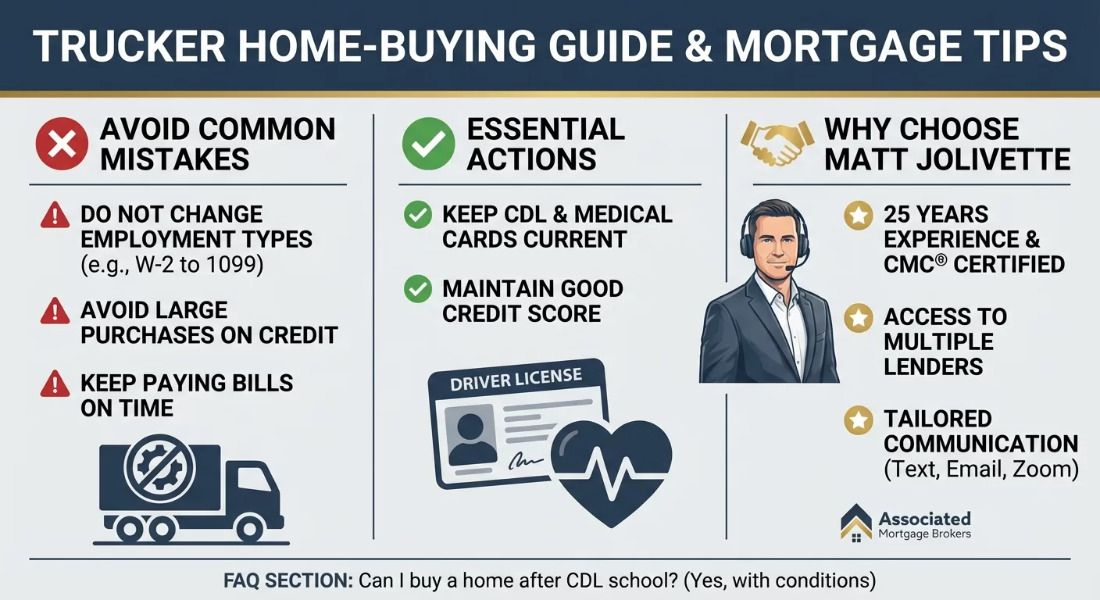
- Discuss a planned employment or business change with your mortgage professional before relying on an earlier preapproval.
- Disclose new debts, large purchases, changes in savings and obligations you have co-signed.
- Keep payments current and provide requested explanations and updated records.
- Confirm how business borrowing affects personal qualification and available funds.
Common questions about mortgages for truck drivers
Can a recent CDL graduate qualify?
A recent CDL graduate may qualify, depending on the documented employment and income history and the loan program. Training alone does not establish mortgage eligibility. Ask the lender which records and employment conditions apply.
Do truck drivers need a large down payment?
The required down payment depends on the loan program, borrower and property. Eligible borrowers may have lower-down-payment options, but closing costs, insurance or program fees and reserves also matter. Compare the full cost before choosing.
Can I qualify with past credit problems?
Past credit problems do not produce the same result under every program. The lender evaluates your credit record, debts, income, assets and any applicable waiting periods. A review can identify next steps without promising approval or a particular score requirement.
Can trucking income support an investment-property loan?
Eligible documented trucking income may support investment-property financing under the chosen lender’s rules. DSCR financing instead emphasizes a lender-defined rental-income analysis, alongside other underwriting requirements. Property use, reserves, credit and loan costs still require review.
Discuss your financing plans
Contact Matt Jolivette, CMC® (NMLS #90661), to review your documentation and compare available options. Call (503) 545-8843, email matt@associatedmortgage.com, or request a mortgage conversation. A request is not a loan approval or commitment to lend.
Educational and program information
Matt Jolivette, CMC® (NMLS #90661), Associated Mortgage Brokers, company NMLS #86136. This content is educational and not financial advice. Loan programs, rates, and guidelines change often. Talk with a licensed mortgage professional about your specific situation before making any decisions. All loans are subject to borrower, property and underwriting approval. Program availability and terms vary by lender and state.