
Why Experts Say Mortgage Rates Could Ease — and What That Means for the Portland–Vancouver…
Overpaying for a Mortgage in Oregon? The 90% Mistake
Overpaying for a Mortgage in Oregon? What the Bankrate Study Doesn’t Tell You
Short answer
A new Bankrate study says 90% of Oregon borrowers likely overpaid on their mortgage. But the study compares real loans to advertised rates that cost thousands in upfront points — and that Bankrate itself says it can’t guarantee. The real fix isn’t a rate table. It’s comparing total cost for the years you’ll actually keep the loan.
A new Bankrate study ranks Oregon near the worst in the country for overpaying for a mortgage. Nationally, Bankrate says 87% of borrowers paid too much. In Oregon, it’s 90.1% — the second-highest rate in the nation. The Wall Street Journal covered it.
But here’s the part most people miss. Bankrate also sells the mortgage marketplace the study says will fix the problem.
So I pulled Bankrate’s own rate table, ran a real Portland-area buyer, and compared it to live pricing from the dozens of lenders I work with every day. It’s the clearest example I’ve seen of why you never shop by rate alone.
Are you really overpaying for a mortgage in Oregon?
First, the study’s claims. Bankrate compared about 3.2 million real closed loans against offers on its own marketplace. Its findings:
- 87% of U.S. borrowers “likely” overpaid on loans taken out since 2022.
- Oregon ranked #2 in the nation at 90.1% — only Pennsylvania was higher.
- The average overpayment: about $3,343 per year, or $78,186 over a full 30-year loan.
90.1%
of Oregon borrowers “likely overpaid” on their mortgage — the 2nd-highest rate in the U.S., per Bankrate’s June 2026 study
So are you really overpaying for a mortgage in Oregon? Read that word again: likely. Bankrate never saw what you were quoted. It never saw why you picked your loan. It built a benchmark number and called everyone above it an overpayer. So let’s test that benchmark.
What does Bankrate’s “best rate” really cost?
I ran a real Portland-area scenario: a $670,000 home, 20% down, 780 credit score. That’s a very strong buyer, shopping just above the Portland metro’s June median sale price of $564,900 (RMLS).
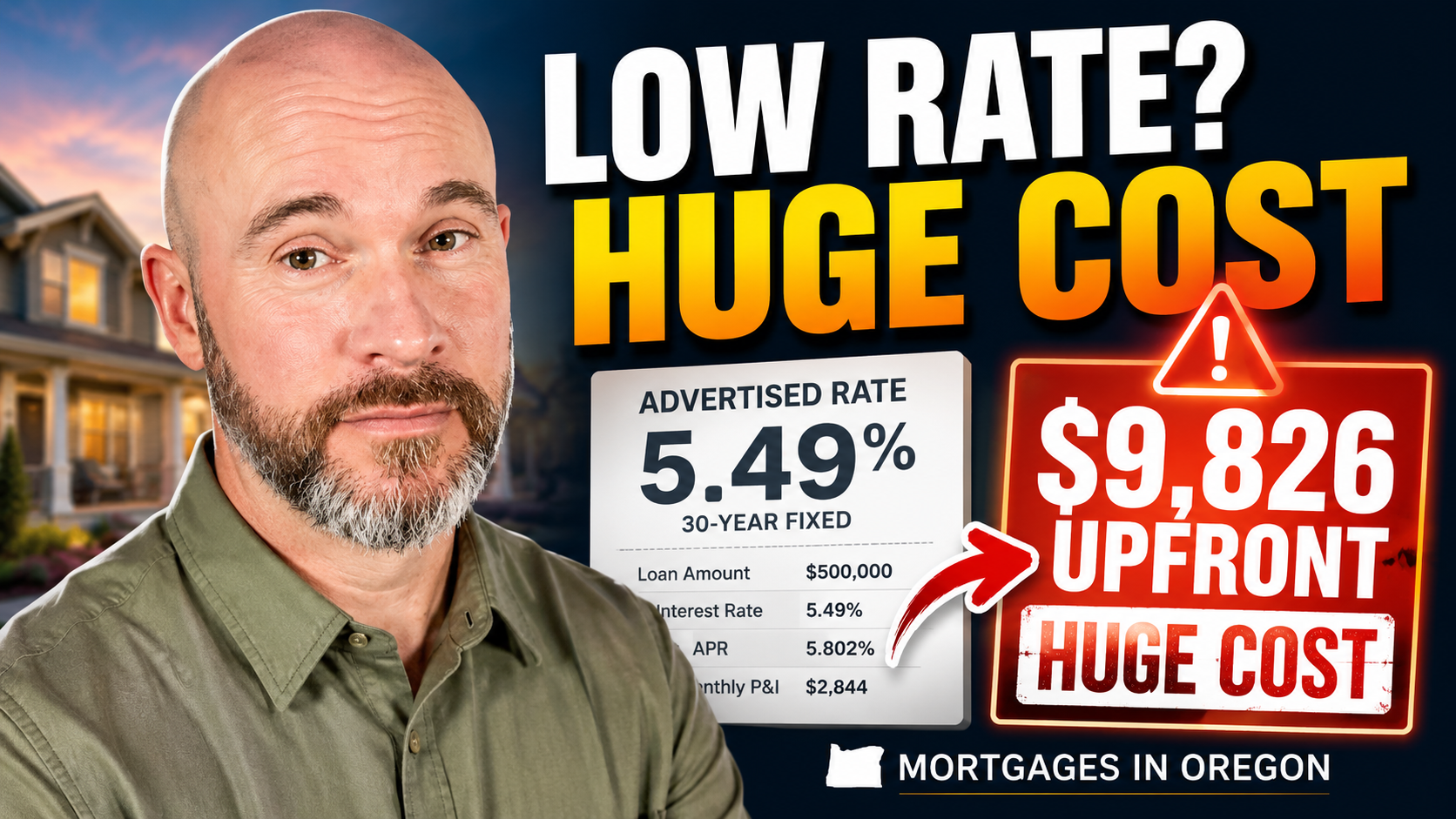
Here’s what Bankrate’s 30-year fixed table showed me for that buyer on June 29th. Every rate looked great. The top one was 5.498% — way below what you’ve been hearing.
But look at the column most people skip: upfront cost.
| Advertised rate | Upfront cost (points & credits) | What that means |
|---|---|---|
| 5.498% | $9,826 | Almost ten grand on day one |
| Next listing | $11,050 | Before any lender fees |
| Next listing | $11,297 | Before any lender fees |
Source: Bankrate.com rate table, $670,000 purchase, 20% down, 780 FICO, pulled June 29, 2026. Rates shown are advertised examples, not offers, and change daily.
And the points are only part of it. Every lender adds its own fees on top — origination, underwriting, processing. Those stack on top of the points you just saw. That’s money out of your pocket before you make a single payment.
So always ask for the total cost, not just the rate.
Why doesn’t that 5.498% rate add up?
Here’s the part that should stop you. I took that exact buyer — 780 credit, 20% down, $670,000 Portland-area home — and priced the same loan across the dozens of lenders I quote every day.
The best rate I could verify for a buyer that strong was right around 6.5%. That’s the real number today.
And it’s not just me. Freddie Mac’s national survey — which tracks borrowers with excellent credit and 20% down — put the average 30-year fixed at 6.49% for the week of July 9, 2026. Bankrate’s table showed that same buyer 5.498%. More than a full point below the national average for the strongest borrowers in the country.
To actually land a rate that low, you’d pay far more in points and fees than the table suggests. I couldn’t reconcile that advertised rate with the pricing I saw for the same scenario. And Bankrate already warned us: its own fine print says it can’t guarantee those rates are accurate — or even available.
By that measure, overpaying for a mortgage in Oregon mostly means you didn’t buy points. The cheap rate isn’t cheap. You either pay for it upfront, or it doesn’t hold
How did the study decide you “overpaid”?
Give Bankrate credit where it’s due. They did real work. Millions of loans. They adjusted for credit, debt, and down payment across 17 factors.
But the core of the comparison is this: they measured millions of real, closed loans — real rates, real points, real people — against marketplace rates like the ones above. Rates that run a point under what the market verifies. Rates that cost five figures upfront to actually get.
That’s not a fair comparison. That’s a real loan versus a billboard.
And try to actually get that billboard rate. You don’t get a quote right away — you get a form. You hand over your name and phone number before you ever see personalized pricing.
Who profits from the study?
So why build the study this way? Look at who built it. Bankrate sells a mortgage auction — the same product the study says will save you. The Wall Street Journal gave it a headline. But the company sounding the alarm is also selling the cure.
And that scary $78,186 lifetime number? It only happens if you keep the loan all 30 years. Almost nobody does.
When is a higher rate actually the smarter loan?
Here’s what a rate table will never tell you: sometimes a higher rate is the smarter loan.
Paying a slightly higher rate can mean thousands less at closing. If you’re moving in a few years, or planning to refinance when rates drop, keeping that cash is often the right call. You skip points you’d never earn back.
The lowest rate only wins if you keep the loan long enough to break even. A rate table doesn’t know your plans. It just crowns the lowest number and calls everyone else a loser.
How does a mortgage broker fix this?
Here’s what the study leaves out completely: you don’t need an online auction to make lenders compete. That’s literally what a mortgage broker does.
I shop dozens of lenders at once. And I show you the real number: the total cost for the years you’ll actually keep the loan. Not a teaser rate. Not a lead form. It costs you nothing to see your options. Then you decide.
If you’re worried about overpaying for a mortgage in Oregon, here’s the fix. Shopping for a mortgage isn’t about finding the lowest advertised rate. It’s about finding the lowest total cost for your situation. Those aren’t always the same thing. That’s the whole job.
Want your real numbers — not a billboard rate?
Whether you’re in Portland, Vancouver, or Boise, find out what you actually qualify for. 15 minutes gets you real numbers, side by side, at no cost.
FAQ: Mortgage overpayment and rate shopping in Oregon
Did 90% of Oregon borrowers really overpay on their mortgage?
That’s Bankrate’s estimate, and Oregon ranked second in the nation in its June 2026 study. But the word is “likely.” The study compares real closed loans to advertised marketplace rates that often require thousands in upfront points and aren’t guaranteed. It’s a useful wake-up call to shop — not proof you personally got a bad deal.
Why is my quoted rate higher than rates I see online?
Advertised rates usually assume you’ll pay discount points — often five figures upfront on a Portland-priced home. They also assume a perfect scenario and come with fine print saying they may not be available. Your quote reflects your actual loan, with real fees, in real time.
What are discount points on a mortgage?
Points are prepaid interest. You pay money at closing to lower your rate. One point costs 1% of your loan amount. Points only pay off if you keep the loan long enough to break even — often five years or more. If you move or refinance before then, that money is gone.
Is it better to take a higher rate with lower closing costs?
It depends on how long you’ll keep the loan. If you plan to move or refinance within a few years, a higher rate with less cash due at closing often costs you less overall. The right answer comes from comparing total cost over your real timeline — not from picking the lowest rate on a list.
How do I actually compare mortgage offers in Portland?
Ask every lender for the same thing: total cost — rate, points, and all lender fees — over the number of years you expect to keep the loan. Or let a broker do it for you. A mortgage broker prices your exact scenario across dozens of lenders at once and shows you the options side by side, at no cost to you.
About the author
Matt Jolivette of Associated Mortgage Brokers is a Mortgage Broker and Certified Mortgage Consultant (CMC) with 26+ years in the industry. He is licensed in Oregon, Washington, and Idaho and serves buyers across the Portland–Vancouver–Hillsboro metro. As an independent broker, he prices loans across dozens of lenders to find the lowest total cost for each client’s situation — a local alternative to big online lenders.
Sources: Bankrate, “The Hidden Homeownership Tax” study (June 2026); Bankrate.com rate table (June 29, 2026); Freddie Mac Primary Mortgage Market Survey (July 9, 2026); RMLS Market Action, Portland Metro (June 2026); The Wall Street Journal.
This article is general information only and is not financial, lending, or investment advice. Rates and figures shown are examples from the dates noted, are not offers of credit, and change daily. Your rate and costs will depend on your specific loan scenario. Loan approval is subject to credit, income, and property qualification. Not all applicants will qualify. Matt Jolivette, NMLS# 90661 · Associated Mortgage Brokers, Company NMLS# 86136 · Licensed in Oregon, Washington, and Idaho. Equal Housing Opportunity.

About the Author
Matt Jolivette
Mortgage Broker at Associated Mortgage Brokers · NMLS #90661
Matt Jolivette is one of two owners of Associated Mortgage Brokers and brings his clients 25 years of experience as a mortgage broker. Matt received his Bachelor of Science degree in Finance from Portland State University, studying and attending classes nights while working full time at Associated Mortgage Brokers, graduating in 2005.
Specializes in: Conventional, FHA, VA
Licensed in: ID, OR, WA
Related Posts